


Educational reforms has always been the pillar of a country’s progress. In a world that is constantly changing, where flexibility and creative thinking drive progress, education becomes more important. To a young and multicultural country like India, access to good education is not just an advantage; it is a prerequisite for national progress and competitiveness
But for years, the Indian education system was stuck in a time warp. Rote memorization, ancient syllabi, examination-driven education, and lack of emphasis on practical skills had left many students unprepared to handle problems of the real world. While the world shifted to creativity, critical thinking, and computer literacy, Indian classrooms were typically bogged down with blackboards and books.
Realizing these challenges, the government and education intellectuals sensed an urgent need for reform. The focus shifted from literacy alone to overall development — to produce curious, capable, and future-ready learners. Holistic reforms began to materialize, particularly after 2014, for school curriculum, teacher training, digital infrastructure, and higher education policy.
This paper undertakes an exhaustive review of the important educational reforms initiated in India between 2014 and 2020 and examines how these reforms aimed to modernize pedagogic practices, bridge existing skill gaps, and facilitate the future generation of Indian intellectuals.
National Education Policy (NEP) 2020 – A Game Changer

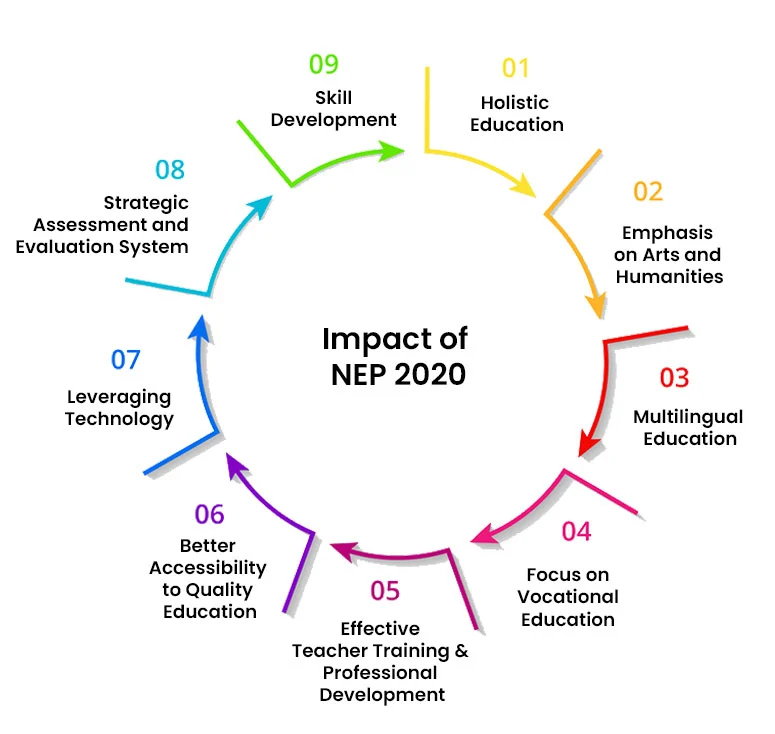
After more than thirty years, India experienced a transformational shift in its education paradigm with the launch of the National Education Policy (NEP) 2020. The precedents had called for greater access to education, but NEP 2020 acknowledged a greater crisis — a gap between access and quality. More children were attending school but learning remained disconcertingly poor, especially in basic areas of reading and numeracy. It was the time for an overhauling, visionary shift.
NEP 2020 was framed on five guiding pillars of utmost significance:
Access, Equity, Quality, Affordability, and Accountability. And its aim? To make India’s education system an inclusive, learner-centric, and future-facing one.
Key Points of NEP 2020:
1. 5+3+3+4 Format
The previous 10+2 scheme was replaced with a new scheme of studies: 5+3+3+4, aligned with foundation (ages 3–8), preparation (8–11), middle (11–14), and secondary stages (14–18). The order is more aligned with the intellectual development of the child and gives priority to early childhood care and education (ECCE).
2. Foundational Literacy and Numeracy (FLN) Mission:
Realizing that children do not generally acquire basic reading and numeracy skills, NEP launched ‘NIPUN Bharat’ to achieve universal FLN at Grade 3. This forms the basis of meaningful learning in subsequent classes.
3. Experiential and Multilingual Learning:
NEP encourages learning through experience, critical thinking, and creativity. It encourages mother tongue/region language teaching up to at least Grade 5, so that there is improved comprehension in the first few years.
4. Board Exam Reforms & PARAKH

Board exams are being redesigned to assess understanding and not memorization. A new national body, PARAKH (Performance Assessment, Review, and Analysis of Knowledge for Holistic Development), will set competency-based standards.
5. Vocational and Digital Learning Integration
Vocational training will be initiated from Grade 6 onwards, along with internships to bridge the gap between education and employment. The policy also focuses on digital literacy and aims to bridge the digital divide through programs such as DIKSHA and SWAYAM. At its core, NEP 2020 is more than a policy document — it’s a blueprint for rethinking Indian education. With its flexible and student-centric approach, it holds the promise to unleash the full potential of India’s demographic dividend.
RTE Act Amendments – Shaping Accountability and Quality
The RTE Act of 2009 was a milestone in providing free and compulsory education to 6-14 years old children. But later, it was revealed that enrolling the children in schools alone would not be sufficient. In order to enhance the quality of education as well as accountability, considerable amendments were brought in the post-2014 years. then we were introduced with Educational Reforms.
One of the most profound was the legal requirement for the integration of Learning Outcomes. The schools were required to ensure students achieved certain competencies at their class level, thus changing the focus from attendance to learning.
Another important reform took on the challenge of underqualified teachers. The government, in 2017, made it mandatory that all in-service teachers without training acquire a professional qualification.
Through NIOS (National Institute of Open Schooling)-sponsored D.El.Ed courses, more than 9 lakh teachers were upskilled — a huge plus towards enhancing the standards of teaching. Besides, the RTE Act was amended to permit detention in Classes 5 and 8 on a performance basis after re-examinations. This was an attempt to re-introduce discipline through academics in a child-friendly manner.

Collectively, these amendments strengthened the very pillars of class instruction, creating a system that fostered greater accountability and excellence in the education system.
Empowering Teachers: NISHTHA Training Initiative
Teachers form the pillar of any education reform. Recognizing this, the Government of India launched NISHTHA (National Initiative for School Heads’ and Teachers’ Holistic Advancement) — a flagship initiative aimed at training teachers and changing classroom practices from rote to competency-based learning.
NISHTHA was launched in 2019 with the objective of developing teachers’ capacity at the foundational, preparatory, and secondary levels. It offers a combination of quality offline and online modules focused on building pedagogical skills, subject matter content knowledge, and inclusive practices in teaching. More than 42 lakh teachers across the nation have been touched since the launch of this program.

The training covers all the major areas like inclusive education, learning through art-integrated learning, the use of ICT in classrooms, and assessment reforms with NEP 2020 orientation. With a view to making teachers innovative and learner-centric in their attitude, NISHTHA aims to make teaching more effective and enjoyable.
Looking forward, the vision is to provide Continuous Professional Development (CPD), with each teacher receiving 50 hours of training annually. NISHTHA is more than just a training program — it is a movement that is meant to empower teachers, improve learning outcomes, and transform India’s classrooms into vibrant and future-ready environments.
Conclusion
Educational reforms are not just policy changes but are rather steps in creating a stronger, more intellectually strong, and more equitable India. The reforms that were initiated in the period between 2014-2020, such as the overhaul of antiquated systems and the development of critical thinking, skill acquisition, and computer literacy, represent a visionary approach towards transforming the face of education in India.
At the core of these reforms lies a straightforward yet compelling fact: education is the key to national development. Education empowers, drives innovation, and builds human capital required for economic and social development. National Education Policy 2020, RTE Act modifications, digital initiatives, and instructor training programs like NISHTHA — all demonstrate India’s resolve to ensure quality and equitable education for everybody.
Education, then, is an evolving field. With society, technology, and global concerns constantly changing, it is imperative that our education system keeps pace. Ongoing reforms, ongoing evaluation, and open policies are the solution to being able to meet the needs of future generations.
For India to become a full-fledged knowledge superpower, reform must be thought of as a process, not an event – a process in which every student is empowered, every teacher is enabled and every classroom is a place of curiosity, growth and possibility.