


States and Capitals of India form the backbone of the country’s administrative divisions. India is a constitutional union consisting of 28 States & Capitals and 8 Union Territories.
India is a constitutional union consisting of 28 States & Capitals of India and 8 Union Territories, with a total of 36 entities. The states and Union territories are segmented into 800 districts and smaller administrative units.
Each has a capital that functions as the legislative, administrative, and judicial center. For general knowledge and competitive exams, it is essential to know the names of states and their capitals .
State Capitals are historically important as they continue to be the centres of trade,political power and culture. Administratively important as it functions as the state’s central hub accommodating the functions and effectively serving as the core where main government operations and decision-making takes place.
There is a recent change in their number of Indian states and Capitals of India and Union Territories in which Jammu and Kashmir was divided into two separate Union Territories , Jammu and Kashmir and Ladakh were reorganised,which effectively reduced the number of states to 28 and increase to number of union territories to 8.This change took effect on october 31,2019.
Complete List of Indian States and Their Capitals

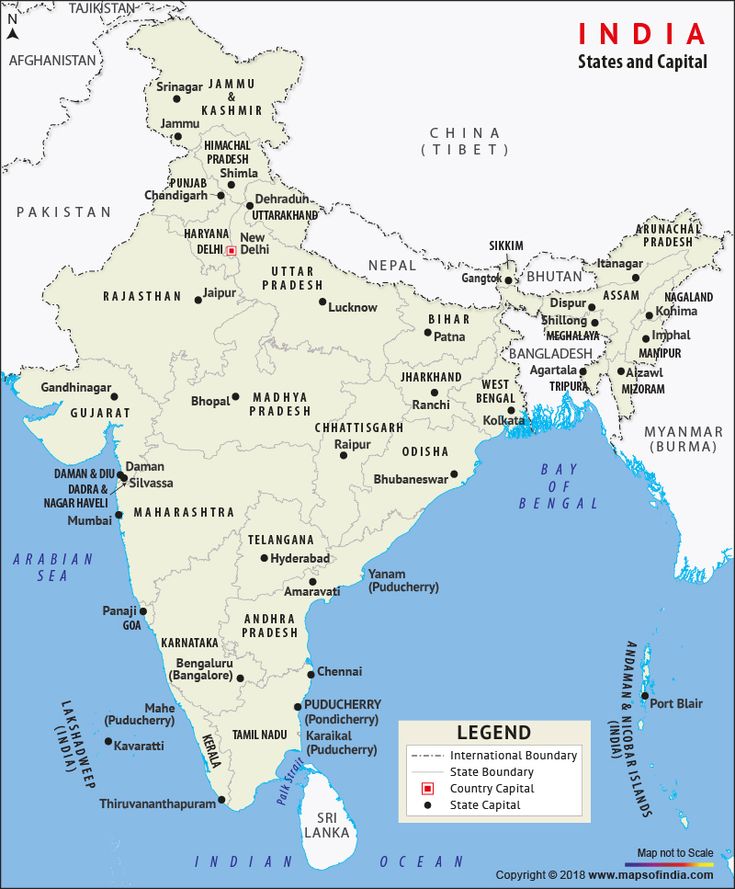
Here is the complete list of 28 States and Capitals of India:
| S.No. | States | Capitals |
| 1. | Andhra Pradesh | Amaravati |
| 2. | Arunachal Pradesh | Itanagar |
| 3. | Assam | Dispur |
| 4. | Bihar | Patna |
| 5. | Chattisgarh | Raipur |
| 6. | Goa | Panaji |
| 7. | Gujarat | Gandhinagar |
| 8. | Haryana | Chandigarh |
| 9. | Himachal Pradesh | Shimla |
| 10. | Jharkhand | Ranchi |
| 11. | Karnataka | Bangalore |
| 12. | Kerala | Thiruvananthapuram |
| 13. | Madhya Pradesh | Bhopal |
| 14. | Maharashtra | Mumbai |
| 15. | Manipur | Imphal |
| 16. | Meghalaya | Shillong |
| 17. | Mizoram | Aizawl |
| 18. | Nagaland | Kohima |
| 19. | Odisha | Bhubaneswar |
| 20. | Punjab | Chandigarh |
| 21. | Rajasthan | Jaipur |
| 22. | Sikkim | Gangtok |
| 23. | Tamil Nadu | Chennai |
| 24. | Telangana | Hyderabad |
| 25. | Tripura | Agartala |
| 26. | Uttarakhand | Dehradun |
| 27. | Uttar Pradesh | Lucknow |
| 28. | West Bengal | Kolkata |
“Understanding the States and Capitals of India helps in grasping our federal structure.”
The Andhra Pradesh government’s decision to establish three capitals – Visakhapatnam as the Executive capital, Amravati as the legislative capital, and Kurnool as the judicial capital – brought Amaravati’s development to a grinding halt three years ago.
A variety of factors are taken into consideration while choosing the capital of a state which includes economy, military & ethnic relations.The study of state’s capital is a comprehensive discipline that encompasses history, politics, geography and urban development.
Union Territories and their Capitals
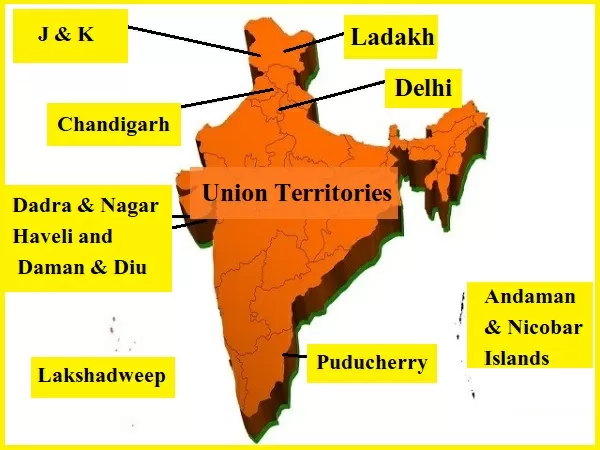
Here is the list of India’s 8 Union Territories and their Capitals:
List_of_state_and_union_territory_capitals_in_India

| Union Territories | Their Capitals |
| Andaman and Nicobar Islands | Port Blairs |
| Chandigarh | Chandigarh |
| Dadra and Nagar Haveli and Daman and Diu | Daman |
| National Capital Territory of Delhi | Delhi |
| Jammu & Kashmir | Summer – Srinagar Winter – Jammu |
| Ladakh | Leh |
| Lakshadweep | Kavaratti |
| Puducherry | Puducherry |
The basic difference between a State and a Union Territory is:
- The Union Territories are directly ruled by the Union Government.
- States have a separate government for administrative purposes.
A nation is defined by its states and Union Territories.
Karnataka is one of the major states of South India, is known for its rich historical heritage. Bengaluru serves as the administrative capital, while Belagavi is regarded as the second capital.
Chandigarh is the Union Territory which is also the capital of two states :Punjab and Haryana.
Why Capitals Matter? The Role of Capital Cities
Capitals are the administrative, economic, and political hubs of a state or a union territory. Capitals are the locations of government offices, legislatures, and high courts, which facilitate effective governance.
Capital cities are industrially, commercially, and infrastructurally developed, which creates employment and state GDP.
Most capitals are of high historical and cultural importance, preserving their heritage while promoting contemporary developments. Their geographical positioning guarantees accessibility and regional equilibrium, with some states possessing more than one capital to enhance efficiency.
Moreover, the capitals are centers of education, tourism, and international recognition, hence promoting innovation and development.
Interesting Facts & Trivia about State Capitals
According to historical records, Delhi(namely New Delhi) is considered as the oldest state capital in India, which functioned as the political and economic hub for several ancient empires, especially the Mughal Empire . The British later shifted Calcutta (now Kolkata) before relocating it to New Delhi in 1911.
Shimla is the Indian state capital located at the highest altitude which is the capital of Himachal Pradesh. Shimla is the most iconic hill station destination in India.
Throughout history, various states have changed their capitals which includes reasons such as administrative efficiency, political considerations or regional growth.
A notable example is Andhra Pradesh , which changed its capital from Hyderabad to Amaravati after Telangana was formed, aiming to establish a new administrative hub in another region of the state.
Delhi is the most populated city in India , with a population of over 33 million people.
The state capital which is known for its rich cultural heritage and history is Andhra Pradesh – Amaravati, located in southeastern India.
Conclusion
State and Union Territory capitals are the governmental nerve centers of economic development, cultural activity, and growth. They are more than the government, determining the fate of their respective areas. As India continues to expand, these capitals will continue to be significant in propelling growth, connectivity, and national identity.